
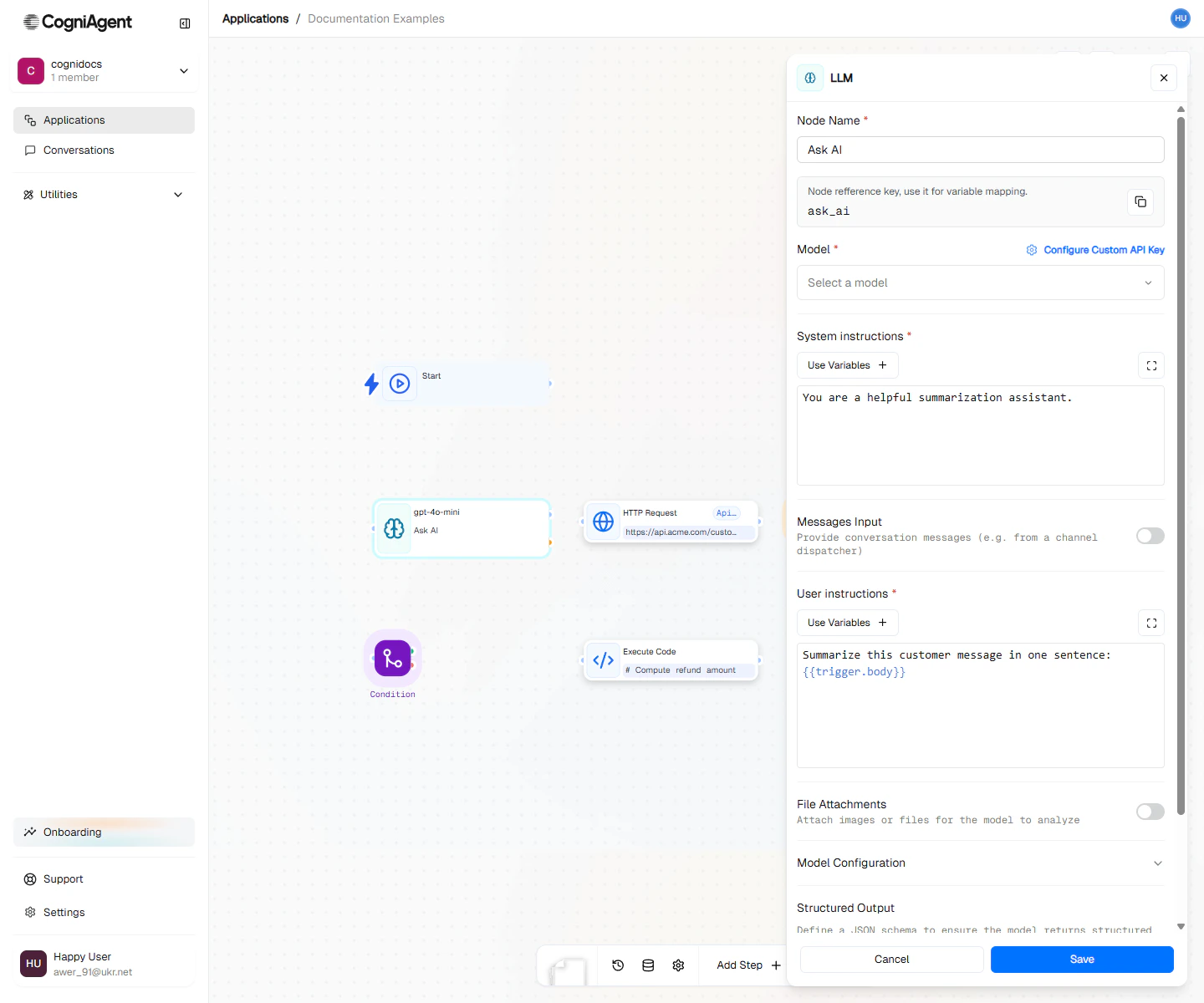
LLM configuration — pick a model, then write the system and user instructions.
When to Use
- Summarizing - Turn a long document into bullet points
- Categorizing - Sort emails into “Sales”, “Support”, “Spam”, etc.
- Extracting - Pull out names, dates, and numbers from messy text
- Writing - Generate email replies, reports, or social posts
- Translating - Convert text to another language
- Analyzing - Detect if a message is positive or negative, urgent or not
- Reformatting - Turn a paragraph into a list, or vice versa
Example: Email Categorizer
Automatically categorize incoming support emails:1
Set up the event trigger
Add an App Trigger node for Gmail to receive incoming emails.
2
Configure LLM
Add an LLM node with:System prompt:User message:
3
Route based on category
Add a Switch step using
{{llm_1.response}} to route to different handling workflows.Example: Meeting Summary Generator
Create structured meeting notes from transcripts: System prompt:Example: Data Extraction
Extract structured data from unstructured text: System prompt:Tips for Getting Good Results
Be Specific About What You Want
Give Background Information
Tell It Exactly How to Respond
Show Examples
Structured Output
When downstream steps need to parse the answer, don’t ask for JSON in the prompt — use the node’s Structured Output setting. Define the fields you want (for examplesentiment, topics, urgency, summary) in the schema builder, and the node returns them as a real object on the structuredOutput output:
Which Model Should I Choose?
Model names and capabilities change frequently. The model selector in the UI shows current options with their capabilities.
Each Call Starts Fresh
Every LLM node call is independent — it has no memory of earlier LLM calls in the workflow. If a later step needs something from an earlier answer, pass it explicitly:Advanced: the messagesOverwrite setting lets you supply the full message history yourself (an array of
{ role, content } messages built by an earlier node), replacing the system/user instructions entirely.Letting the AI Use Your Apps
The LLM node isn’t limited to text. In the config panel you can enable Built-in Skills — Web Search and Web Extract (both on by default) and Execute Python Code — and bind Integrations: connected apps like Gmail, Jira, or Slack whose actions the model can call as tools while the step runs. That turns a single LLM step into a mini agent: it can look up an email thread, create a ticket, and then write its answer — all in one node.LLM Integrations
Bind connected apps to the node, choose which actions the model may call, and guide it with per-action usage notes.
Saving Money on AI Costs
- Use simpler models for simple tasks - Don’t use GPT-4 when GPT-3.5 would work fine
- Keep responses short when possible - If you only need a yes/no answer, don’t allow long responses
- Save results to reuse later - Use Update Variable so you don’t have to ask the same question twice
- Skip AI when you don’t need it - Use If / else steps to avoid unnecessary AI calls
Tips
Settings
string
default:"LLM"
What to call this node (shown on the canvas).
string
default:"llm_1"
A short code to reference this node’s response.
string
required
Which AI provider to use — OpenAI, Anthropic, Google, and others. Pick it with the visual model selector.
string
required
Which specific AI model to use. Newer/larger models are smarter but cost more. The selector shows each model’s capabilities (images, audio, files, and more).
string
required
System instructions — background context that tells the AI how to behave.
string
required
User instructions — what you want the AI to do. You can include data from previous nodes using
{{node_name.value}}.array
Files to send along with the instructions — images, audio, PDFs, and more. See Working with files and AI.
number
default:"0.7"
How creative vs. consistent the AI should be. 0 = same answer every time. 1 = more varied and creative. Part of the collapsible Model Configuration section.
number
default:"1000"
How long the response can be. A token is roughly 3-4 characters for English text (varies by language and content).
number
default:"3"
How many times to try again if something goes wrong.
object
A schema describing the fields you want back. When set, the node returns a parsed object on the
structuredOutput output.object
Toggles for the built-in skills: Web Search and Web Extract (on by default) and Execute Python Code (off by default).
array
Connected apps and the actions the model may call. Configure them in the Integrations section — see LLM Integrations.
Outputs
string
The model’s text response.
object
The parsed object matching your Structured Output schema (only when the schema is configured).
string
The model’s reasoning content, when the selected model exposes it.
string
Why the model stopped generating:
stop- Natural completionlength- Hit max tokens limit
object
Results of every skill and integration action the model called, grouped by tool name.
array
Files the model generated (images, audio, charts) or that its tools produced — usable by later nodes.
array
Integrations that could not be offered to the model — for example, because their connection was removed or disabled.
string
The model that actually served the call.
string
The resolved user instructions that were sent to the model.
boolean
Whether the call completed. On failure,
error holds the details.Related Nodes
LLM Integrations
Let the model call actions on your connected apps.
Execute Workflow
Run another workflow you’ve built and use its output.
Execute Code
Process AI responses with custom code.