
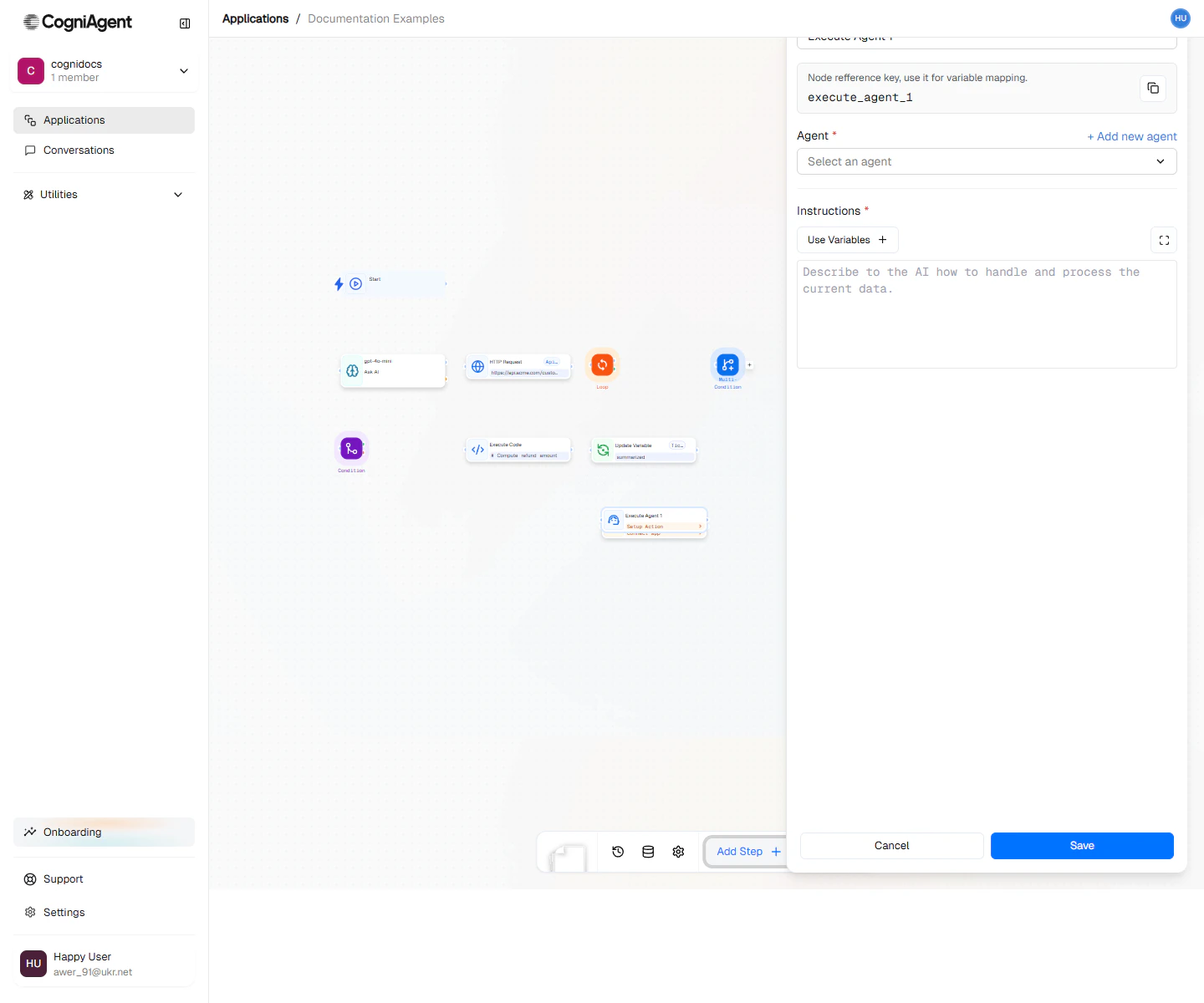
Execute Workflow configuration — pick the target workflow and map values into its input arguments.
When to Use
- Reusable logic - Encapsulate common workflows (email parsing, data validation) and call them from multiple places
- Complex sub-processes - Break large workflows into manageable pieces
- Team collaboration - Different team members can own different workflows
- Versioning - Update a shared workflow without modifying every workflow that uses it
- Separation of concerns - Keep workflows focused on one responsibility
Example: Lead Qualification Pipeline
A main workflow that uses specialized workflows for each step:1
Receive the lead
Use a Webhook node to receive new lead data from your website form.
2
Enrich the lead
Execute Workflow: Lead Enrichment WorkflowThis workflow looks up company info, social profiles, and tech stack.
3
Score the lead
Execute Workflow: Lead Scoring WorkflowThis workflow applies your scoring model and returns a score.
4
Route based on score
Use an If / else node to route high-score leads to sales, others to nurture campaigns.
Example: Document Processing Hub
A central workflow that routes documents to specialized processors:Example: Approval Workflow
Use workflows to encapsulate approval processes: Main workflow:Passing Data
Input Arguments
The target workflow declares its input arguments on its Start node. In the Execute Workflow node you map a value to each argument — values can use{{...}} expressions resolved from the current execution:
The called workflow receives these as its starting input.
Receiving Results
The called workflow’s output becomes available as{{execute_workflow_1.result}}:
Design Patterns
Microservices Pattern
Break your automation into small, focused workflows:
Main workflows compose these workflows as needed.
Facade Pattern
Create a simplified workflow that orchestrates complex operations: Customer Onboarding Workflow (called by main workflow):Chain of Responsibility
Pass data through a series of processing workflows:Execution Behaviour
Execute Workflow always waits for the called workflow and returns its output — it is not a fire-and-forget trigger. How the target runs depends on the target workflow’s execution mode: a single-instance workflow reuses its live execution (deploy it first), while a multi-instance workflow starts a fresh run.Recursion is allowed — a workflow may call itself or another entry point of the same workflow — but you own loop termination. Gate recursive calls behind an If / else.
Error Handling
When a called workflow fails, the Execute Workflow node captures the error:{{execute_workflow_1.status}} to handle failures gracefully.
Tips
Settings
string
default:"Execute Workflow"
Display name shown on the canvas.
string
default:"execute_workflow_1"
Unique identifier for referencing outputs.
string
required
The workflow (application) to run. Select from a dropdown of workflows in your workspace.
string
required
The entry node in the target workflow — a Start node that declares the input arguments callers must pass.
array
One row per declared argument: the argument name and the value to pass. Values can use
{{...}} expressions from the current execution.number
Override how long to wait for the called workflow to finish.
Outputs
object
The called workflow’s final outputs, keyed by node key — its return value.
boolean
Whether the called workflow completed successfully.
string
Execution status of the called run.
string
Unique identifier for the run of the called workflow.
number
How long the called workflow took to run (in milliseconds).
string
Error details when the call fails.
Related Nodes
LLM
For simple AI tasks, an LLM node may be sufficient without a full workflow.
Execute Code
For data processing, code might be simpler than an workflow.