
The three things that accumulate
Memory
Notes about you, your preferences, and the work. Built from corrections you make in passing.
Skills
Procedures worth repeating — written by you, or proposed by your coworker and approved by you.
Instructions
The standing brief, which you tighten as you learn what it gets wrong.
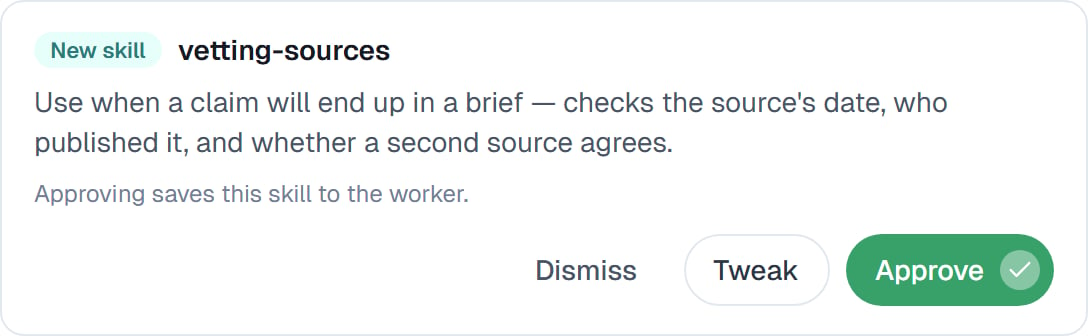
A proposal, with exactly what approving would do spelled out underneath it.
Your part in it
The single highest-return habit: correct it in the chat, in plain words, in the moment.“Too long — half that next time.” “Always check the date on a pricing page before you quote it.” “Don’t use that source, it’s unreliable.”Each of those is a sentence you’d say to a colleague, and each one lands as something your coworker keeps. This is why it improves — not from watching you, but from you telling it.
What your coworker does on its own
It notices patterns in its own work and proposes changes: a new skill for a procedure that worked well, a fix to one that didn’t, a note worth keeping. You approve, tweak or dismiss each one. Tweaking is underrated — a proposal is a decent first draft, and five minutes tightening it turns it into something that actually gets used. There’s also an optional periodic tidy-up of the skills it has written for itself, off by default. See Skills that improve themselves.What a month looks like
1
Week one — you correct a lot
Format, tone, which sources it trusts, how much detail you want. This feels like work. It is, and it’s the whole investment.
2
Week two — patterns emerge
You notice you’ve said the same thing three times. Write the skill.
3
Week three — proposals start being good
Its suggestions on the Improvements tab start matching what you’d have written.
4
Week four — you stop thinking about it
The output arrives in your format, with your standards applied, and you check rather than fix.
Good to know
Improvement belongs to one coworker. Three coworkers each learn their own job. Save a well-tuned one as a template to give a new hire the same starting point — skills and instructions carry, memory doesn’t.
Common questions
Can it change itself without asking?
Can it change itself without asking?
No. Every change to its skills, memory or instructions waits for your approval on the Improvements tab.
How often should I check that tab?
How often should I check that tab?
Every couple of weeks. Proposals accumulate harmlessly, and reviewing a few at once is easier than one at a time.
Does correcting it slow things down?
Does correcting it slow things down?
A sentence in the chat costs nothing and saves the same correction every task afterwards. It’s the highest-return thing you can do.
Does the underlying AI get better too?
Does the underlying AI get better too?
Models improve, and you can switch to a newer one at any time. What’s yours — the skills, memory and instructions — carries across.
What if it learned something wrong?
What if it learned something wrong?
Open the Memory tab and delete the note, or edit the skill. Everything it learned is visible and editable.
Next steps
Skills that improve themselves
Reviewing what it proposes.
What a coworker remembers
Reading and fixing its notes.
Creating a skill
When a correction becomes a procedure.
Autonomy overview
Earning unattended work.