
What it does
Open your coworker’s Files tab and you’ll find them both, each with a plain-language label: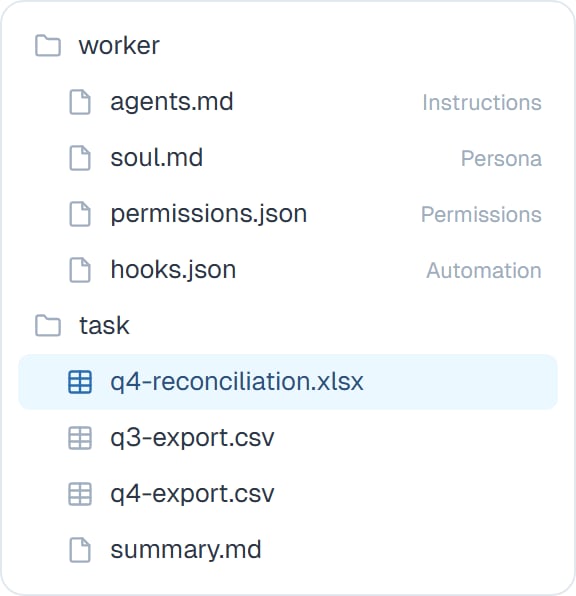
Both live on the Files tab, labelled in plain language so you're never editing something whose job you have to guess.
Writing good instructions
The best instructions read like what you’d tell a capable new hire on their first day. Not a specification — a briefing. Say what the job is, not just the topic.Weak: “You handle research.” Better: “You answer questions that need a decision behind them. Every claim carries a source. If the evidence is thin, say so rather than filling the gap.”Say what good looks like. Your standard is not obvious. If you want three options and a recommendation rather than an essay, write that down. Say when to stop and ask. This is the most valuable line most people never write. “Ask me before contacting anyone outside the company” prevents more problems than any setting. Say what to leave alone. Boundaries are as useful as instructions. “Don’t touch pricing questions — send those to me.”
Writing a good persona
Shorter than you think. Three or four sentences is usually plenty.Direct and unfussy. Leads with the answer, then the reasoning. Never pads a reply to seem thorough. With customers, warm but not chatty.The test: could a colleague read this and imitate the voice? If not, it’s too vague.
When you’d change them
- The coworker keeps making the same wrong assumption
- You find yourself repeating a correction in every task
- Its output is right but the tone is off for the audience
- The job has genuinely changed
- You want it to ask before something it currently does on its own
Good to know
Instructions are for how this coworker works in general. A procedure with steps that must happen in order belongs in a skill instead.
Instructions, skills, or memory?
All three shape behaviour, and it’s worth knowing which to reach for.Common questions
How long should instructions be?
How long should instructions be?
A few paragraphs. Long instructions dilute — if everything is emphasised, nothing is. Put procedures in skills and keep instructions to the standing rules.
Will editing these lose what it has learned?
Will editing these lose what it has learned?
No. Instructions and memory are separate. Rewriting the job description doesn’t erase what it picked up about how you like things.
What if I do not write any?
What if I do not write any?
A coworker built from scratch with no instructions is a general assistant — capable, but with no view on what matters to you. Ten minutes of writing is the highest-return thing you can do.
Next steps
What skills are
For procedures, not standing rules.
What a coworker remembers
What it picks up on its own.
The five ready-made coworkers
Well-written instructions to borrow from.
Permission rules
Boundaries you enforce rather than ask for.