
What it does
Correct your coworker once — “shorter, and lead with the recommendation” — and it writes that down. Next task, it does it that way without being told. That’s the whole feature. It’s also the thing that makes a coworker feel different from a chatbot after a fortnight: it has actually learned how you work.The four kinds of note
Open the coworker’s Memory tab and each note is one of these.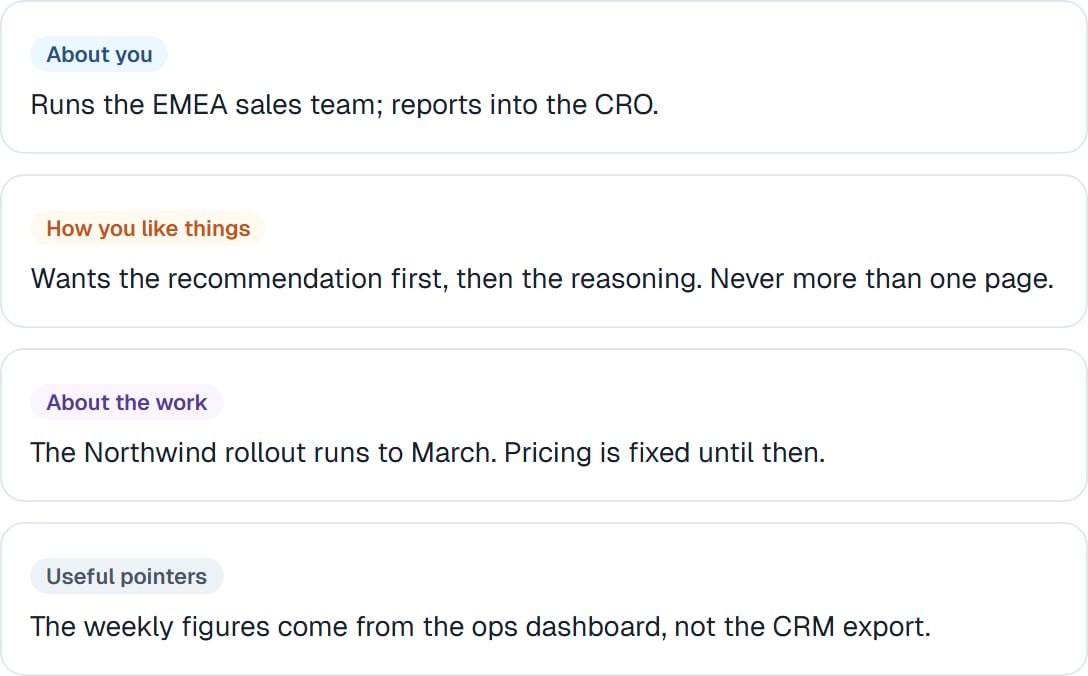
Four notes, one of each kind. Nothing is remembered about you that you can't read.
Reading and editing them
Everything is visible. Nothing is remembered about you that you can’t read. You can edit a note that’s drifted, or delete one that’s wrong. Deleting is genuinely useful — a note saying you prefer something you’ve stopped preferring will keep shaping the work until you remove it.Telling it to remember
You don’t have to wait for it to notice. “Remember that I always want the figures in euros” works, and lands as a note. Equally, “forget what you know about the pricing structure, it changed” clears the stale one.What memory isn’t
The line: instructions are what you told it, memory is what it learned. If you find yourself editing memory a lot to force a behaviour, that behaviour belongs in the instructions.
Good to know
Memory belongs to one coworker. Two coworkers build separate pictures of you, which is usually right — your analyst and your assistant need to know different things.
Memory doesn’t carry when you save a coworker as a template. A fresh hire builds its own — see Retiring, re-hiring and templates.
Common questions
Does it remember everything I say?
Does it remember everything I say?
No. It keeps things that look durable — a preference, a constraint, a fact about the work. The detail of one conversation stays in that conversation.
Can I stop it remembering something?
Can I stop it remembering something?
Delete the note. You can also just say “don’t remember that”.
Why does it keep doing something I corrected?
Why does it keep doing something I corrected?
Check the Memory tab — often there’s an older note pulling the other way. Deleting the stale one usually fixes it in one go.
Do my colleagues see my coworker's memory?
Do my colleagues see my coworker's memory?
Memory belongs to the coworker, so anyone using that coworker benefits from it. Keep genuinely personal material out, and give yourself your own coworker if you need to.
Can it propose a note itself?
Can it propose a note itself?
Yes — memory notes turn up as proposals on the Improvements tab for your approval. See Skills that improve themselves.
Next steps
Giving instructions
What you set deliberately.
How a coworker gets better
Turning notes into habits.
Long conversations
Memory inside one task.
What skills are
Remembering how, not what.