
A tour of Workspace files: the Files page, a coworker writing into it, versions and checkpoints, who may change what, the Concierge and workflows.
What it does
Workspace files is the folder your workspace shares. You find it at Cowork → Files, under Workspace. Put a price list, a template or a customer database there once, and everyone who needs it reaches the same copy: you and your teammates, your coworkers, your workflows, the Concierge, and the AI tools you connect. Nothing is lost quietly. A file keeps its last three versions, you can name a version as a checkpoint that stays until someone removes it, and the Files page shows who changed what, with a link to the task or workflow run that did it.When you’d use it
- “Every coworker should quote from this year’s price list, and I want to change it in one place.”
- “Nora writes the weekly report. I want to fix a figure myself and still have her original.”
- “Supplier invoices land in a folder, and a workflow should read each one as it arrives.” See Workspace files in workflows.
- “We keep a small customer database that a workflow updates every night.” See Use a SQLite database with Workspace files.
- “I want to ask the Concierge about a report without copying it into the chat.” See Workspace files and the Concierge.
- “A coworker made something in a task that I want to keep.” Find it under the task on the Files page, choose Save to Workspace… and pick a folder: a copy lands in the shared folder.
Who works in it
In a chat message, a file in the folder is named as
@files/ and its path, so a coworker or the Concierge knows exactly which file you mean.
What it looks like
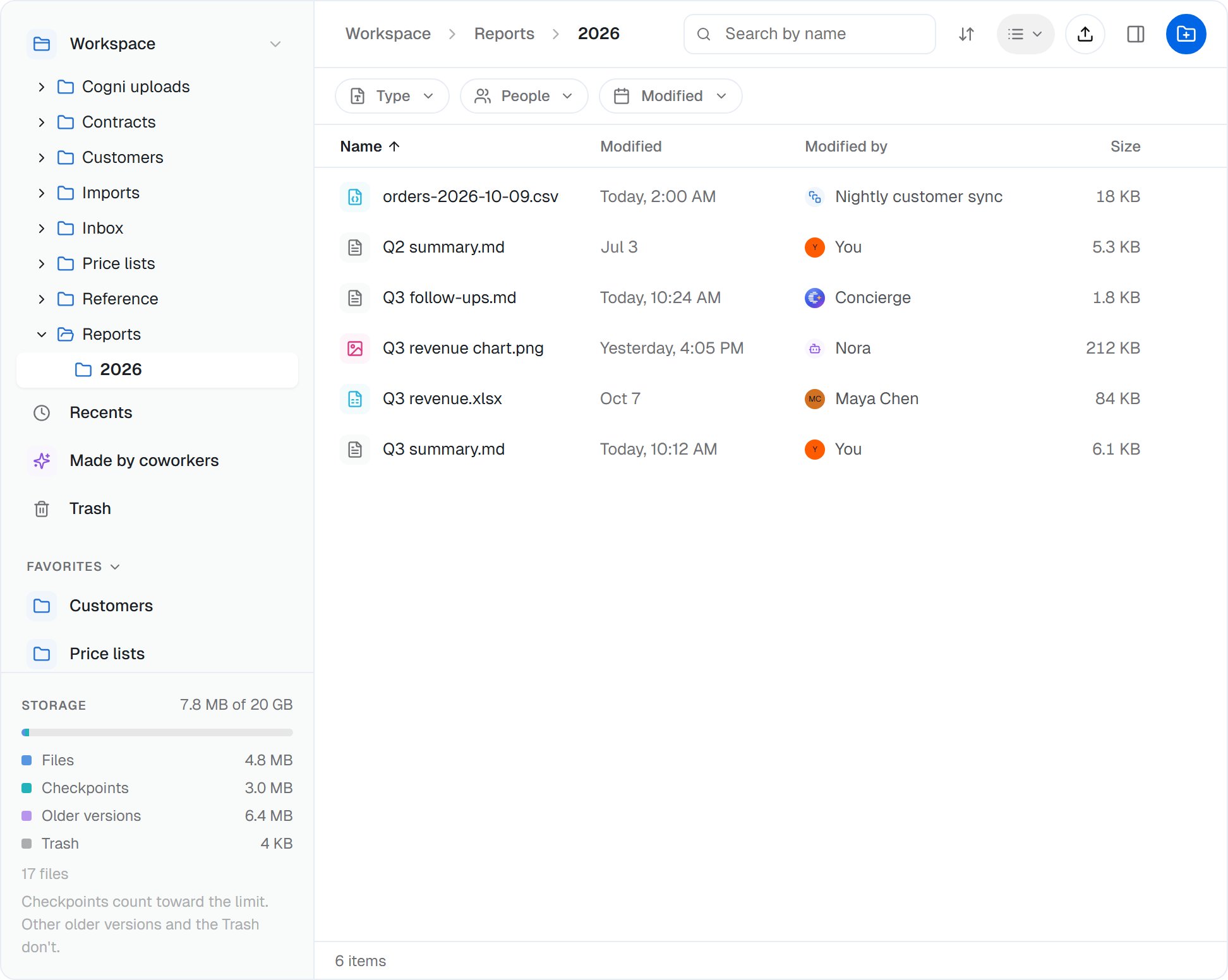
The Files page: the shared folder's folders on the left, and in the list who last changed each file, a person, a coworker, the Concierge or a workflow.
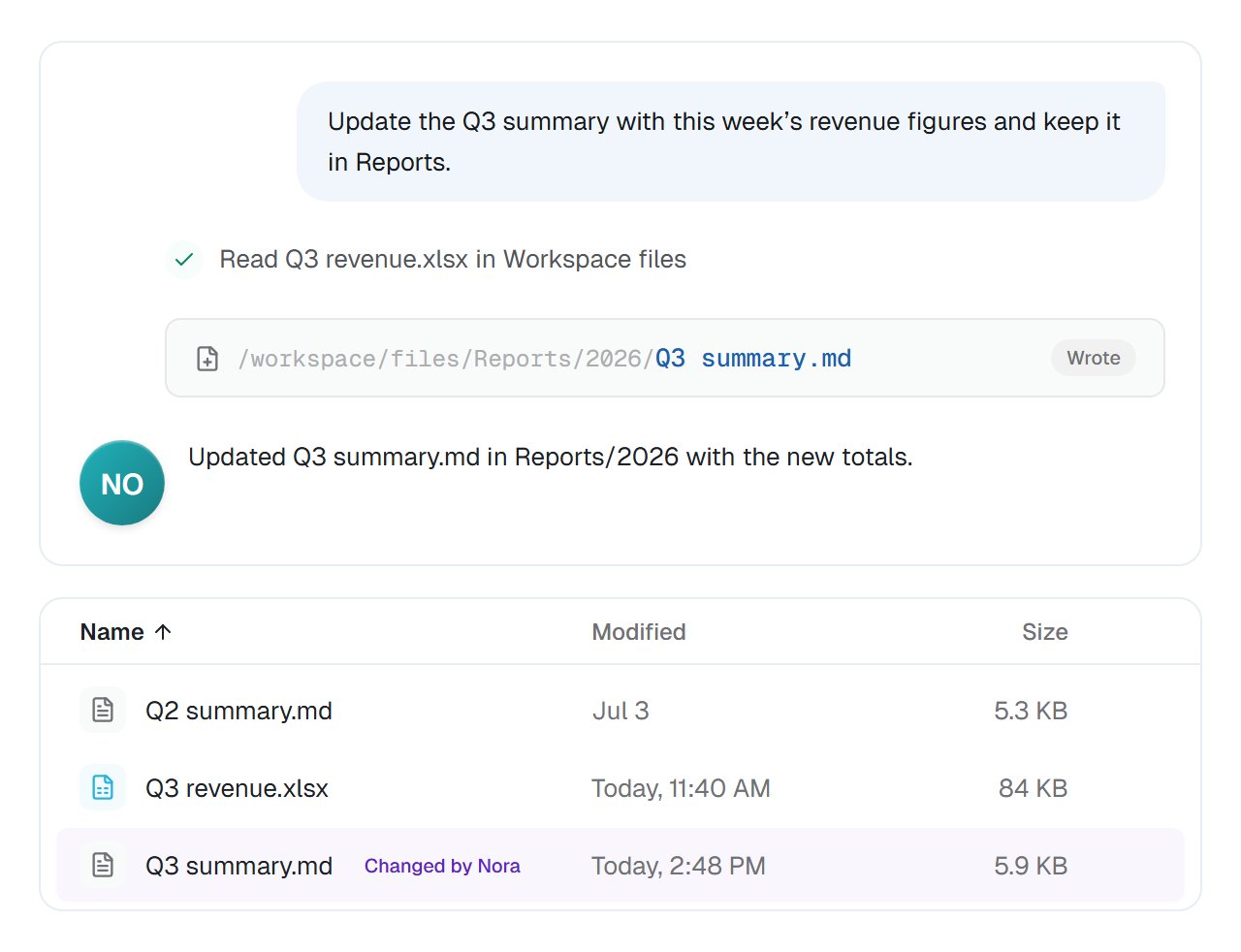
Nora saves the report from her task; on the Files page the row arrives, marked Changed by Nora.
Good to know
A workspace holds up to 20 GB, and the storage bar on the Files page shows how much is used. Older versions and the Trash don’t count toward it; checkpoints do.
Deleting a file moves it to the Trash, where anyone in the workspace can restore it for 30 days. After that it is removed for good.
Each task still has its own files on the coworker’s cloud computer, private to that task. Workspace files is the one folder they all share. The shared workspace a coworker offers in a handover is something else: two coworkers working in the same task files.
Common questions
Can my coworkers see everything in Workspace files?
Can my coworkers see everything in Workspace files?
Every coworker with Code and files on reads the whole folder from its tasks. You choose, per coworker, whether it can also change files there. With Can view, what it changes stays on its cloud computer and never reaches the folder. See Sharing and access.
What happens if two people change the same file?
What happens if two people change the same file?
If someone saves while you’re editing, the editor tells you before you save and lets you choose: compare, save yours as a copy, reload theirs or overwrite. When a coworker’s save, or a workflow’s Execute Code step, crosses someone else’s change, theirs is saved beside the file as a conflicted copy, so neither is lost. A Workspace Files step that writes over a file adds a new version by default, so the earlier one stays in the history. See Editing and file history.
How far back can I go?
How far back can I go?
A file keeps its last three versions, the current one included. Replaced versions are kept for up to 30 days. To keep a version for good, make it a checkpoint: up to three per file, kept until someone removes them.
Is there a size limit?
Is there a size limit?
The Files page uploads files up to 5 GB each. The workspace as a whole holds up to 20 GB.
Can a workflow or a coworker overwrite my work?
Can a workflow or a coworker overwrite my work?
A coworker’s or a workflow’s save becomes a new version, and it never pushes out a version a person wrote. However often an automation saves, your edit stays in the file’s history to restore, for up to 30 days after it’s replaced, or for good as a checkpoint.
Next steps
The Files page
Browse, upload, organise and find files.
Editing and file history
Versions, checkpoints, compare and restore.
Sharing and access
Who sees which files, and what coworkers may change.
Workspace files in workflows
Start, save and update from your workflows.